

Opening
I counted 83 financing and M&A events in October, with about $10.6B of disclosed capital across the twelve segments. Most of it was M&A: roughly $7.7B, against about $2.9B of new financing. One deal made the month. Proofpoint, owned by Thoma Bravo, is buying Varonis for $6.3B in cash, the largest cyber transaction of 2026. IonQ paying $1.3B for Elisity, a microsegmentation company, came next.
October was consolidation in data, network and services. The new financing went to agent security. Across the whole market, ROS has the same picture: offensive security is the fastest-growing category over the last twelve months (23 deals, $847M against $188M a year earlier), and data protection funding more than doubled to $3.67B.
What moved the month
Exits beat entries. About $7.7B of disclosed M&A against about $2.9B of financing, led by Varonis ($6.3B, DSPM plus email) and Elisity ($1.3B), both announced 12-15 October.
The public incumbents raised cash for the AI cycle. SentinelOne issued $1.25B of convertible notes. Sophos refinanced $200M with GTCR.
Venture money went to AI security. Armadin raised a $255.5M Series B at a $2.5B valuation (a16z, Accel, In-Q-Tel, Kleiner), the largest of 14 AI security deals.
Services rolled up by count. 21 security services transactions, mostly MSSP and advisory acquisitions under $50M.
Market-wide (ROS, last twelve months): AI-for-security went from 35 to 40 deals and from $320M to $664M.
The map
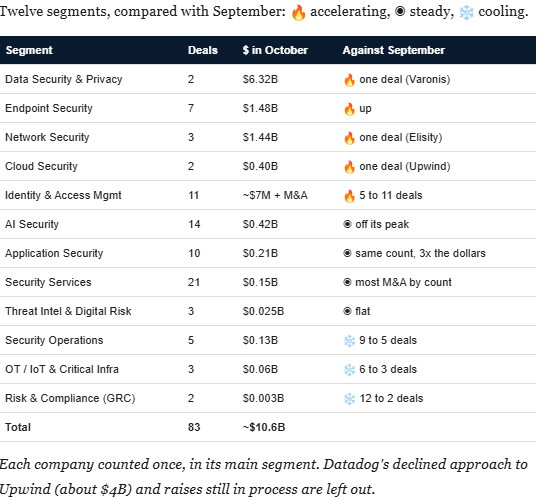
Three things I take from October
1. Agent identity is being assembled by acquisition
Identity had eleven deals, up from five, and nearly all were acquisitions. Workday bought ConductorOne (authorization and governance), Oso went to Tiny, Zluri to Info-Tech, Torii to Freshworks, and Vista carved HID’s PKI business out. Cisco’s roughly $400M move on Astrix and Ping building an agent identity control plane point the same way: platforms want the authorization pieces every AI agent in production will need. Find every non-human identity, issue short-lived scoped tokens, never let an agent hold more standing access than the person behind it. On the recovery side, Acsense closed a $5M bridge at a $30M cap and Hydden raised too. My read: platforms are absorbing the primitives, but nobody owns governance and recovery built for agents from the start. That is where I want to be looking.
2. Security for AI agents is now its own market
Fourteen AI security deals, about $425M. Armadin’s $255.5M Series B at $2.5B (a16z, Accel, Bain, In-Q-Tel, Kleiner) was the anchor. Behind it: Rein Security ($25M Series A), Opsin ($21M, data-access governance for AI), Harmonic Security ($50M Series B, data protection for GenAI), Pluto, and Asymptote Labs ($5.5M seed, open-source agent telemetry). Anthropic also acqui-hired Opaque Systems, a confidential computing company, which tells me “we never keep your prompts” is heading towards something a customer can verify in hardware. Each startup is picking a point in the agent lifecycle: identity, runtime data access, testing and containment. A year ago I would have called that a feature list. In October it had its own rounds.
3. AI-written code is pulling AppSec money towards the moment before deploy
Application security stayed at 10 deals, but disclosed dollars rose roughly 3x to about $208M. That was a $70M seed for Truth, a $40M Series B for Infisical (secrets management, $600M valuation), and acquisitions of Scopertos ($55M), HexAI ($35M, to Hex-Rays) and OpenZeppelin (smart-contract audits, to S&P Global). The acquirers are buying the mature surface: audits, reverse engineering, secrets. What nobody owns yet is the check that runs before an AI-built app goes live, at a time when around 380,000 apps from no-code and AI platforms ship with broken authentication. ROS points the same way, with offensive security the fastest-growing category across the market. QuestorAI (Paladin Capital, $3M seed) and CodeWall, a UK pre-seed backed by Osney, are early into that gap.
Outside the twelve segments
ROS has post-quantum moving across the market too: second fastest, 6 to 11 deals, $533M. I still saw no pure-play PQC round in October. I would source that gap. Resilience for critical infrastructure keeps coming up in my theses more than in the deal flow, though Fortem’s $50M counter-drone round, led by Lockheed Martin, shows the defense side of it is getting funded. Services had 21 deals, mostly the long tail consolidating out of sight of the headline numbers.
What I’ll watch in November: whether any of October’s $2.9B of new venture money turns the agent-security ideas into priced Series A rounds, or whether the big platforms keep buying the pieces first.
- F.